

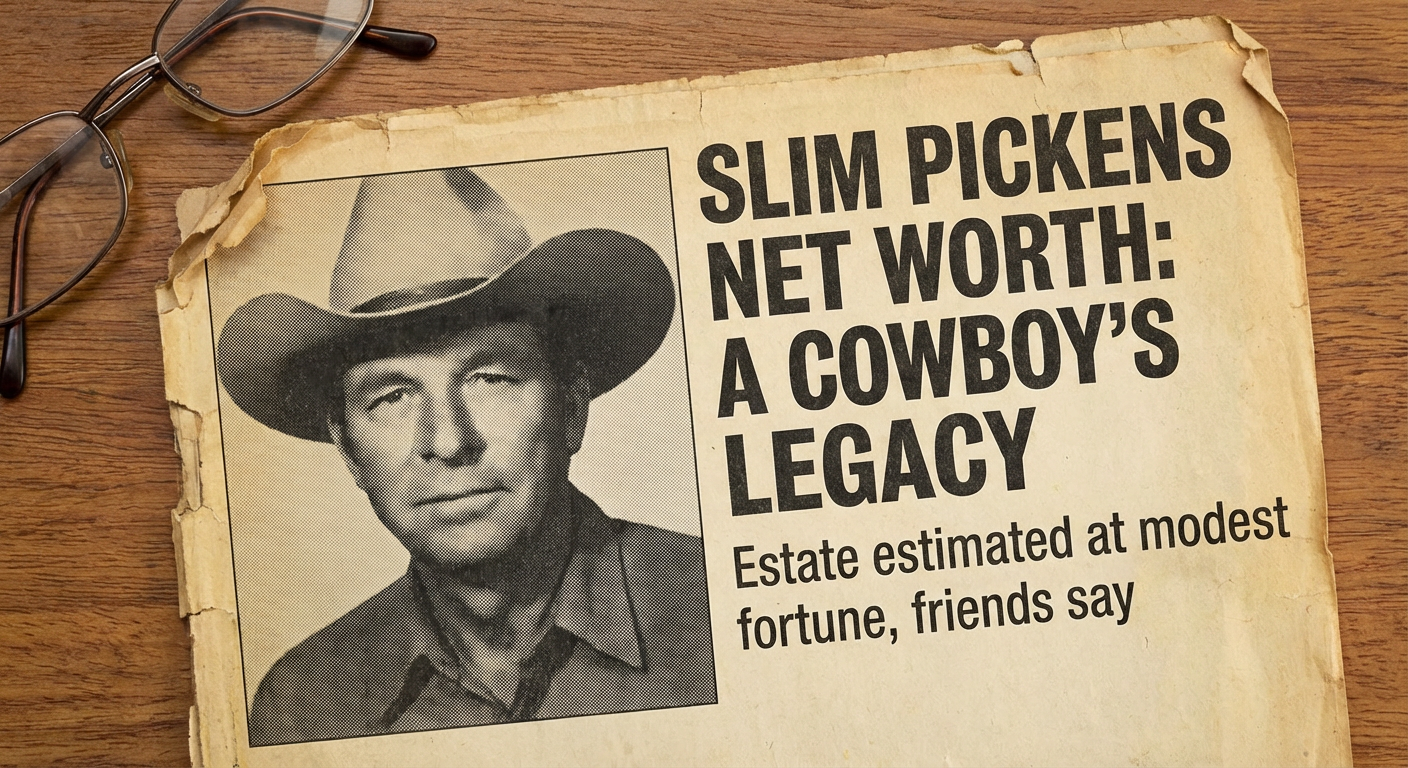
The image of a cowboy, donning a wide-brimmed Stetson and waving a hat while riding a nuclear missile toward the apocalypse, is one of the most indelible sights in cinematic history. That man was Louis Burton Lindley Jr., better known to the world as Slim Pickens. While his name might evoke the rugged simplicity of the American West, his financial footprint and career longevity were anything but “slim.” At the time of his passing in 1983, Slim Pickens had established himself as a premier character actor, leaving behind a legacy that was as fiscally sound as it was culturally significant.
The Early Days: From Rodeo Dust to Hollywood Gold
To understand the net worth of Slim Pickens, one must first look at his unconventional entry into the entertainment industry. Born in 1919 in Kingsburg, California, Pickens did not attend prestigious acting schools. Instead, he spent nearly two decades on the rodeo circuit. He began competing at the age of 12, eventually becoming a highly respected rodeo clown and bronc rider.
During the 1930s and 1940s, rodeo work was grueling and often low-paying. However, Pickens excelled, earning a reputation for his bravery and comedic timing. It was during this era that he adopted his stage name. When he told a rodeo promoter he wanted to sign up, the promoter reportedly told him there would be “slim pickin’s” for prize money. He took the name and turned it into a brand that would eventually be worth millions in modern adjusted dollars.
The Transition to Film: Building the Foundation
Pickens’ transition to the silver screen occurred in 1950 with the film Rocky Mountain, starring Errol Flynn. His authentic drawl and genuine horse-riding skills made him an immediate asset to the Western genre. Throughout the 1950s, he became a staple in “B-Westerns” and television series, providing a steady stream of income that far exceeded his earnings in the rodeo ring.
During this period, actors of his stature were typically paid per film or per episode. While he wasn’t yet commanding high “A-list” salaries, his sheer volume of work—appearing in dozens of productions such as The Great Locomotive Chase and The Last Command—allowed him to build a stable financial foundation. Unlike many of his peers who struggled with the transition from silent films or radio, Pickens’s persona was perfectly suited for the booming era of television Westerns like Bonanza and Gunsmoke.
The Dr. Strangelove Turning Point
The true catalyst for Slim Pickens’ net worth and international fame came in 1964 with Stanley Kubrick’s Dr. Strangelove or: How I Learned to Stop Worrying and Love the Bomb. Cast as Major “King” Kong, Pickens was reportedly not the first choice (the role was originally intended for Peter Sellers), but his performance became the soul of the film.
This role shifted his market value. He was no longer just a “Western actor”; he was a character actor with global recognition. This allowed him to command higher fees for subsequent roles. Estimates suggest that during the peak of his career in the 1960s and 70s, Pickens was earning the modern equivalent of mid-six figures per major film appearance.
Diversification: Voice Work and Commercials
A significant portion of Pickens’ net worth came from his versatility. He understood that his voice—a gravelly, warm, and distinctly rural instrument—was a commodity. He voiced characters in animated features and was a frequent guest on variety shows and talk shows, including The Tonight Show Starring Johnny Carson.
Furthermore, Pickens was a pioneer in celebrity endorsements for the “everyman” market. He appeared in various commercials, leveraging his “trustworthy cowboy” image to sell everything from automotive parts to outdoor gear. These residual income streams were vital in maintaining his wealth during years when he chose to take fewer acting roles.
Estimating the Net Worth at the Time of Passing
When Slim Pickens passed away in 1983 following surgery for a brain tumor, his estate was substantial. While exact tax records of that era remain private, historians and financial analysts estimate his net worth at the time of his death to be between $3 million and $5 million.
In today’s economy, adjusted for inflation, that figure would be roughly equivalent to $10 million to $15 million. This wealth was comprised of:
- Real Estate: Pickens owned a significant ranch in Columbia, California, reflecting his lifelong love for the outdoors and livestock.
- Residuals: Ongoing payments from his 150+ film and television credits.
- Investments: Like many stars of his era, Pickens invested in land and cattle, assets that generally held their value well against inflation.
The “Blazing Saddles” Era and Final Works
The 1970s provided a final financial boom for Pickens. His role as Taggart in Mel Brooks’ Blazing Saddles (1974) introduced him to a younger generation. The film was a massive box-office success, and Pickens’ performance as the dim-witted henchman is still cited as one of the highlights of the comedy genre. He continued to work consistently until his health declined, appearing in hits like The Getaway, Pat Garrett and Billy the Kid, and the horror-comedy The Howling.
The Intangible Wealth: A Lasting Legacy
Beyond the dollars and cents, Slim Pickens’ “net worth” can be measured in his influence on the industry. He proved that a performer didn’t need to fit the “leading man” mold to achieve financial independence and legendary status. He stayed true to his roots, never losing the humble perspective he gained during his “slim pickin’s” days on the rodeo circuit.
He was inducted into the Western Performers Hall of Fame at the National Cowboy & Western Heritage Museum, an honor that cemented his status as a cultural icon. For Pickens, wealth wasn’t just about the balance in a bank account; it was about the ability to live a life on his own terms, split between the glamour of Hollywood sets and the quiet dignity of his ranch.
Conclusion
Slim Pickens’ financial journey is a classic American success story. He transformed a nickname born of poverty into a brand synonymous with authenticity. Through a combination of relentless work ethic, iconic roles in masterpiece cinema, and savvy personal branding, he ensured that his family was well-provided for and his name would live on in the annals of film history. While he may have started with nothing but a saddle and a dream, he ended his career as one of the most respected and financially successful character actors of the 20th century.
